Go Karting in the Rain: How to Be Fast in the Wet
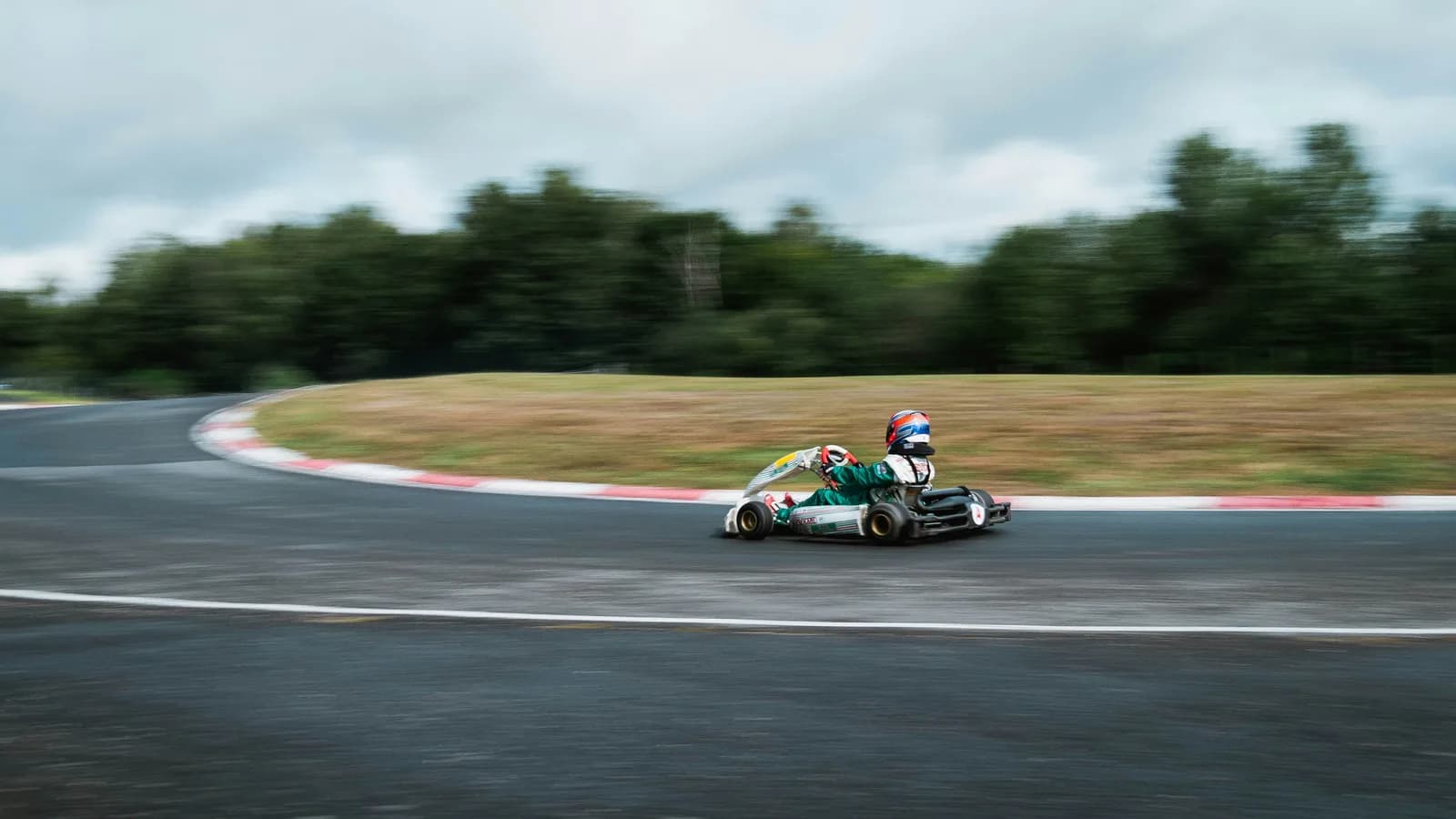
Being fast in the rain comes down to four things: drive off the dry line where the grip actually is, brake earlier and in a straight line, feed the power in like the pedal is made of glass, and keep your eyes further ahead than feels natural. Rain is the great equalizer in karting. Engine advantages shrink, and the driver who adapts fastest wins by seconds, not tenths. That is why so many champions grew up loving wet races.
Most drivers lose time in the rain for one simple reason: they keep driving the dry line with slower inputs. The wet track rewards a genuinely different lap, and it is learnable. Here is what changes, and how to practice it.
Why the dry line is slow in the rain
Months of racing lay rubber and oil into the dry racing line. Add water and that strip becomes the slickest part of the circuit, like paint in the rain. The grip moves to the rough, unrubbered asphalt off-line: the outside of corner entries, the inside curbs, the parts of the track nobody uses on a dry day. This is why wet karting looks so strange from the fence, with karts entering corners wide and crossing the normal line at odd angles. They are not avoiding the corner; they are following the grip.
The wet line, corner by corner
- Enter wide, off the rubber. Stay outside the dry line on approach, where the asphalt is rough and grippy.
- Square the corner off. Brake and turn later than in the dry, cross the slick dry line as briefly and as straight as possible, and apex late.
- Exit on the rough stuff. A late apex points the kart straighter down the next straight, so you can feed the power in earlier on asphalt that will actually take it.
The pattern is the same one that makes a slow-in, fast-out corner work in the dry, just exaggerated. If you already think in terms of corner entry versus exit, the wet simply moves the whole trade further toward the exit. Our guide to corner entry vs exit explains that trade in the dry, and it matters double in the rain.
Braking and power in the wet
A kart brakes on the rear axle, and a wet rear axle locks easily. Brake noticeably earlier than your dry marker, do it while the kart is still pointed straight, and release progressively as you turn. On power, the rule is patience: wait until the kart is pointed where you want it, then feed the power in smoothly. A snap of wheelspin mid-corner costs more than a cautious exit ever will. Smoothness is not slower in the rain; it is the only thing that is fast.
Eyes, hands, and body
Look further ahead than usual. Standing water, rivers across the track, and drying patches change lap to lap, and you steer where you look. Keep your hands loose; a death grip on a sliding kart turns small corrections into big ones. And accept that the kart will move around underneath you. In the wet, a small constant slide is normal and fast; the mistake is fighting it with sharp inputs.
Wet setup in thirty seconds
Driving matters more than setup in the rain, but the basics: fit wets, raise tire pressures well above dry settings so the tire works up to temperature, and shift grip balance forward (many drivers widen the front track). Every kart and class differs, so treat it as a starting point. For the full picture, see how weather conditions affect your kart setup.
What the data shows in the rain
Wet sessions are where a data logger earns its keep, because feel is least reliable exactly when conditions are strange. Three things to look at: your braking points from the longitudinal G trace (are you still braking at dry markers?), your minimum corner speeds lap over lap (they climb steadily as you find the wet line), and your line on the GPS track map (are you actually driving off the dry line, or just slower on it?). Compare wet laps only against wet laps; a wet session judged against your dry best just says "slower everywhere" and teaches nothing. If you log conditions with your sessions, finding a fair wet reference lap later takes seconds, and comparing your first wet stint against your last one shows exactly which corners you adapted in, and which you are still driving like it is dry.
See it on a real session
The quickest way to make this click is to look at real data. The live demo walks through a full kart session, speed traces, track map, sector deltas, and an AI coaching report, with no account needed.
Kart Track Team
Telemetry analysts at Kart Track
The Kart Track team builds Speed Lab, the telemetry analysis engine behind karttrackapp.com. We spend our days parsing MyChron and Alfano data and building the speed traces, track maps, and AI coaching reports that turn raw laps into specific, corner-by-corner feedback for kart racers.