Corner Entry vs Exit: Which Is Costing You More?
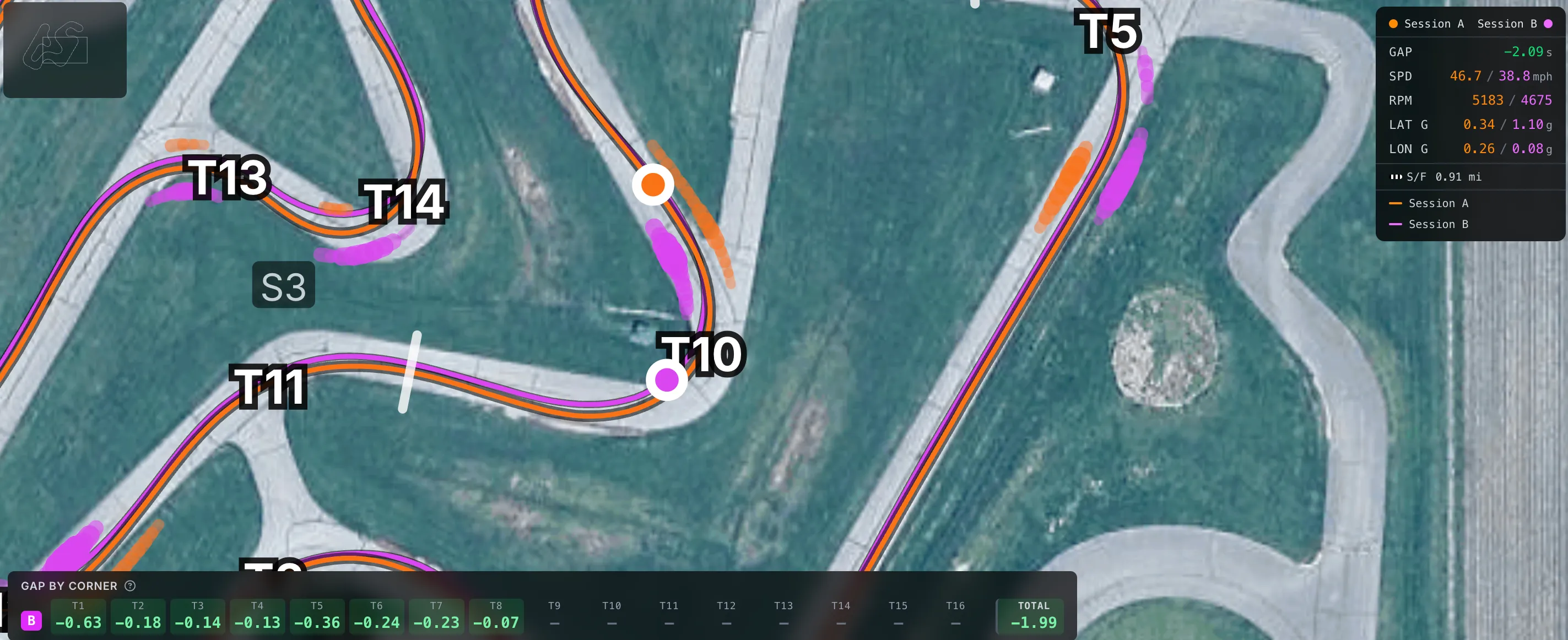
In most corners, a slow exit costs more than a slow entry, because exit speed carries down the entire following straight while entry speed only affects the corner itself. Telemetry tells you which one you are losing: a slow entry shows up as braking too early or a low minimum speed, a slow exit shows up as a late return to power and a lower speed onto the straight.
“Am I losing it on the way in or the way out?” is one of the most useful questions a kart driver can ask, and data answers it cleanly. The two mistakes feel similar from the seat but look completely different in the traces, and they are worth very different amounts of lap time.
How do I tell entry from exit in the data?
Split each corner into three phases and read the right channel for each.
| Phase | What it is | Read this |
|---|---|---|
| Entry | Braking and turn-in to the minimum speed | Longitudinal G (braking) and where speed bottoms out |
| Mid | The slowest point of the corner | Minimum speed and peak lateral G |
| Exit | From the minimum speed back to full speed | When the speed trace starts rising again |
A slow entry shows up as braking that starts too early, a braking spike that is too deep, or a minimum speed that arrives too soon and too low. A slow exit shows up as a speed trace that starts climbing late, and a lower speed where the trace meets the next straight.
Why is a slow exit more expensive?
Because the cost is multiplied by the straight that follows. If you exit a corner 3 km/h slow and a 400 meter straight follows, you carry some version of that deficit the whole way down, and it can even compound as the faster kart pulls a bigger gap at higher speed. A slow entry, by contrast, mostly costs you inside the corner itself. So when you find both on the same lap, fix the exit of the corner that leads onto the longest straight first. It pays back the most.
There is a karting-specific reason exits are precious: no differential. When you get back to power, the kart wants to run wide and the inside rear can struggle to rotate. A clean exit is partly a driving skill and partly a chassis question, which is why exit problems are worth looking at from both angles.
When does entry matter more?
Entry matters most in two situations. First, in a corner that leads into another corner rather than a straight, where exit speed has nowhere to pay off, so carrying speed through the entry and middle is what counts. Second, in a long, fast sweeper where you are not really braking and the whole corner is about minimum speed and commitment. In both cases the speed trace, not the acceleration onto a straight, is your guide.
Which should I work on first?
- Find the corner that leads onto your longest straight. Check its exit first. This is usually your single biggest opportunity.
- For corners that flow into other corners, prioritize minimum speed and a tidy entry over exit drive.
- If entry and exit are both off in the same corner, fix entry enough to set up a good minimum speed, then chase the exit. A good exit depends on a good entry.
Seeing it on your own laps
This is exactly what per-corner analysis is built for. Speed Lab breaks the lap into corners, separates entry, minimum speed, and exit, and its advanced views like the Corner Scorecard and an entry-versus-exit breakdown show you which phase is costing you in each corner. You can see it on a real session in the live demo. The braking side is covered in finding your braking points, and the full method is in finding lap time with data.
See it on a real session
The quickest way to make this click is to look at real data. The live demo walks through a full kart session, speed traces, track map, sector deltas, and an AI coaching report, with no account needed.
Kart Track Team
Telemetry analysts at Kart Track
The Kart Track team builds Speed Lab, the telemetry analysis engine behind karttrackapp.com. We spend our days parsing MyChron and Alfano data and building the speed traces, track maps, and AI coaching reports that turn raw laps into specific, corner-by-corner feedback for kart racers.