How to Find Lap Time in a Kart With Data
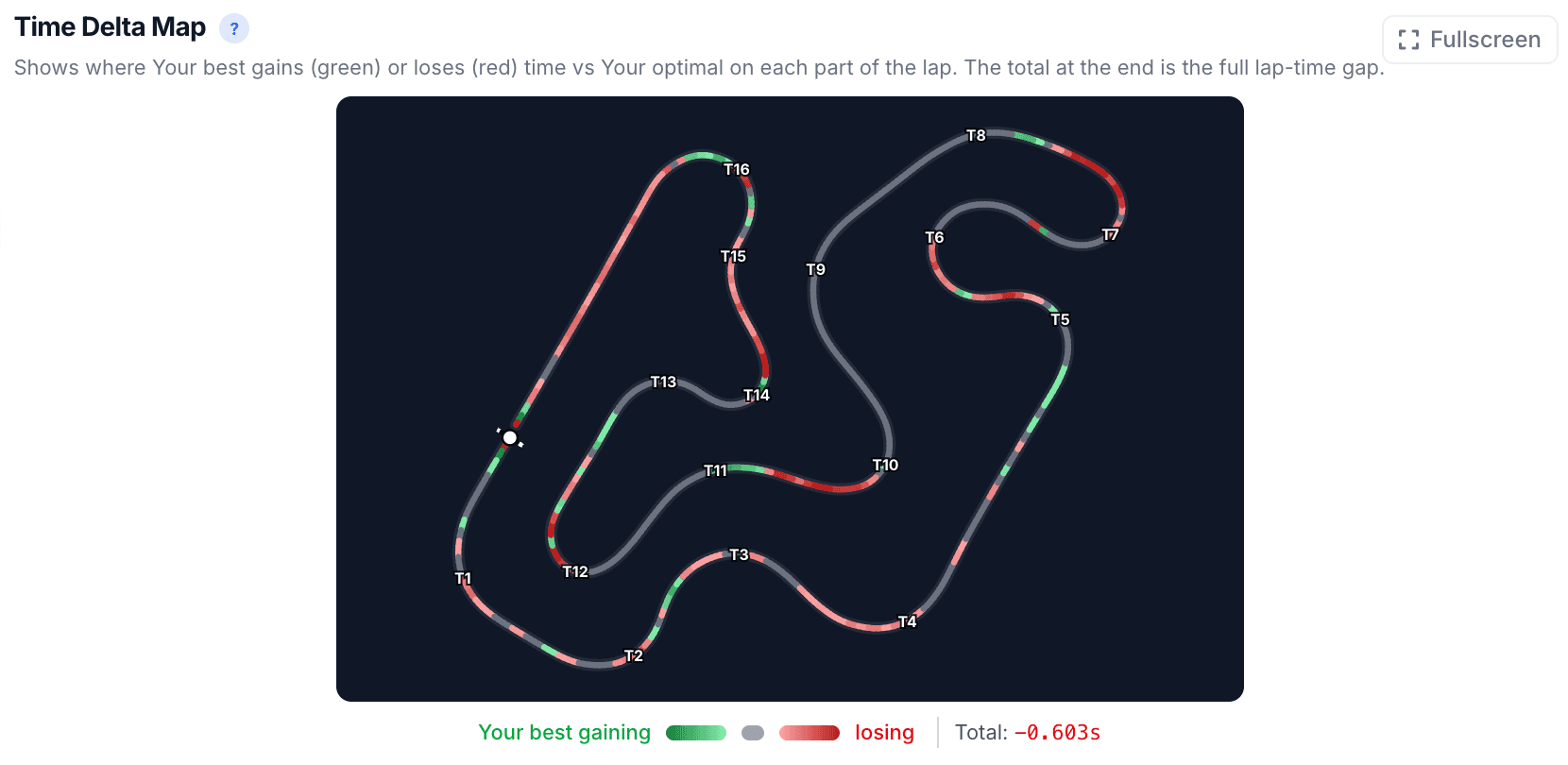
Finding lap time in a kart with data is a repeatable method, not a guess. Overlay your fastest lap against a slower one, read where the speed trace and the time delta diverge, check braking from the longitudinal G trace and minimum speed in each corner, then fix the two or three corners giving up the most. Most drivers find their first few tenths in an afternoon.
“Try harder” is not a plan. Data turns lap time into something you can actually chase, because it shows you where the time is, not just that it exists. This is the pillar post for the method. Each section links to a deeper how-to.
Where does lap time actually come from?
Almost all of it comes from corners and the way you connect them to straights. A few hard truths from looking at thousands of kart laps:
- Minimum corner speed matters more than top speed. A kart with no diff punishes lost mid-corner speed twice.
- Corner exit is usually worth more than corner entry, because the exit speed carries down the whole following straight.
- Big single mistakes are rare. Lost time is usually spread across two or three corners, each giving up a few hundredths.
- Consistency is speed. The gap between your best lap and your average lap is often free time.
How do I find my braking points?
On a kart with no brake sensor, you read braking from the longitudinal accelerometer. The downward spike in longitudinal G is the brake event: where it starts is your braking point, and how deep it goes is how hard you slowed. Overlay two laps and you can see who braked later and who released the brake sooner to let the kart roll. The full method, including how to brake later without overshooting the corner, is in finding your braking points from telemetry.
Entry or exit: which is costing me more?
This is the question that focuses your effort. A slow entry and a slow exit look different in the data, and they are worth different amounts depending on what follows the corner. A slow exit onto a long straight is one of the most expensive mistakes in karting. We show you how to tell them apart, and which to fix first, in corner entry vs exit.
How do I use sector deltas?
Sector deltas split the lap into chunks and show how much time each chunk gained or lost against your reference lap. The rolling time delta does the same thing continuously, so you can watch the gap open and close corner by corner. Read them well and you can stitch your best sectors from different laps into a single theoretical best lap, then go drive it. That is covered in reading sector deltas to find the fastest line.
A simple process to find time
| Step | What you do | What you are looking for |
|---|---|---|
| 1 | Overlay your best lap on a slower one | Where the speed traces split apart |
| 2 | Read the time delta | The exact corners where the gap grows |
| 3 | Check minimum speed in those corners | A lower valley you can lift |
| 4 | Check the braking trace into them | Braking too early, too hard, or too long |
| 5 | Check when acceleration begins on exit | A late return to power onto the straight |
| 6 | Pick the two biggest and fix those | One change at a time, then re-measure |
Notice the last step. Do not try to fix six corners at once. Find the two that cost the most, work on those, and measure again. Lap time comes off in layers.
Do I have to read all this by hand?
No. Learning to read the traces is worth it, and Race Studio will show you everything if you put in the time. But if you would rather have the work done for you, Speed Lab overlays your laps, draws the time-delta map, and writes an AI coaching report naming your top three focus areas with the data behind each one. Try it on a real session in the live demo, or see how the tools compare in the best MyChron analysis app roundup.
See it on a real session
The quickest way to make this click is to look at real data. The live demo walks through a full kart session, speed traces, track map, sector deltas, and an AI coaching report, with no account needed.
Kart Track Team
Telemetry analysts at Kart Track
The Kart Track team builds Speed Lab, the telemetry analysis engine behind karttrackapp.com. We spend our days parsing MyChron and Alfano data and building the speed traces, track maps, and AI coaching reports that turn raw laps into specific, corner-by-corner feedback for kart racers.