Finding Your Braking Points From Telemetry
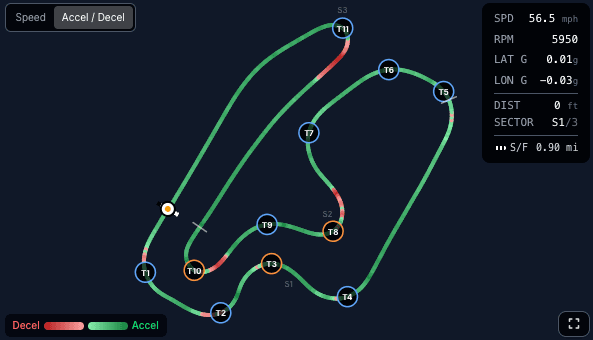
Most karts have no brake sensor, so you read braking from the longitudinal G trace. The point where longitudinal G spikes downward is your braking point, and the depth of the spike is how hard you slowed. To find time, compare two laps and look for who braked later, slowed less, and released the brake sooner to let the kart roll to its minimum speed.
Braking is where a lot of kart lap time is won and lost, and it is also the most misunderstood, because there is usually nothing directly logging the brake. Here is how to read it properly from the data you do have.
How do I see braking without a brake sensor?
You read it from the longitudinal accelerometer. When you brake, the kart decelerates, and deceleration shows up as a downward spike in longitudinal G. A typical kart braking event might pull somewhere around 1.0 to 1.5 G of deceleration, depending on grip, tires, and how hard you hit the pedal. The trace gives you three things at a glance: where braking starts (your braking point), how hard you brake (the depth of the spike), and how long you stay on the brake (the width of the spike).
Where exactly is my braking point?
It is the spot on track where the longitudinal trace turns sharply downward from zero. Line it up against the GPS track map and you can see the physical point where you began slowing. Overlay a faster lap and a slower lap, and the braking points often sit in different places. The driver who brakes a few meters later, all else equal, carries more speed into the zone and spends less of the lap slowing down.
Should I just brake later?
Later, but not recklessly. Braking later only helps if you can still hit your minimum speed at the right point and get the kart turned. Brake too late and you overshoot: the trace will show you arriving too fast, then either running wide or having to stay slow longer to recover, which kills your exit. The goal is not the latest possible braking point. It is the latest braking point that still lets you roll the kart to a good minimum speed and get back to power early. Read the braking trace together with your speed trace so you see both halves.
What does good braking look like in the data?
- A firm initial hit. The strongest braking happens early, when the kart is still going fast and the tires can do the most work. The trace spikes hard right after the braking point.
- A clean release. The longitudinal trace eases back toward zero as you trail off the brake and let the kart roll. A driver who stays hard on the brake all the way to the minimum speed usually over-slows.
- A handoff to lateral G. As braking ends, lateral G builds. A smooth crossover, brake easing as cornering load rises, is the signature of a kart that is being driven on the limit without being upset.
How do I know if I am braking too hard?
Compare your minimum speed to your potential. If the braking spike is very deep and your minimum speed dips well below your fast lap, you scrubbed too much. The fix is often to brake a touch earlier but lighter, trailing off sooner, so the kart rolls through the corner instead of stopping and re-accelerating. Counterintuitively, an earlier, softer brake can produce a faster corner than a late, hard stab. The data will tell you which one you are doing.
Put it together
Braking points are one piece. They feed directly into the entry-versus-exit question and into your minimum speed, so read them as part of the whole corner. The method across all of it is in finding lap time with data, and corner entry vs exit is the natural next read. To see your own braking traces lined up automatically, upload a session in the live demo.
See it on a real session
The quickest way to make this click is to look at real data. The live demo walks through a full kart session, speed traces, track map, sector deltas, and an AI coaching report, with no account needed.
Kart Track Team
Telemetry analysts at Kart Track
The Kart Track team builds Speed Lab, the telemetry analysis engine behind karttrackapp.com. We spend our days parsing MyChron and Alfano data and building the speed traces, track maps, and AI coaching reports that turn raw laps into specific, corner-by-corner feedback for kart racers.